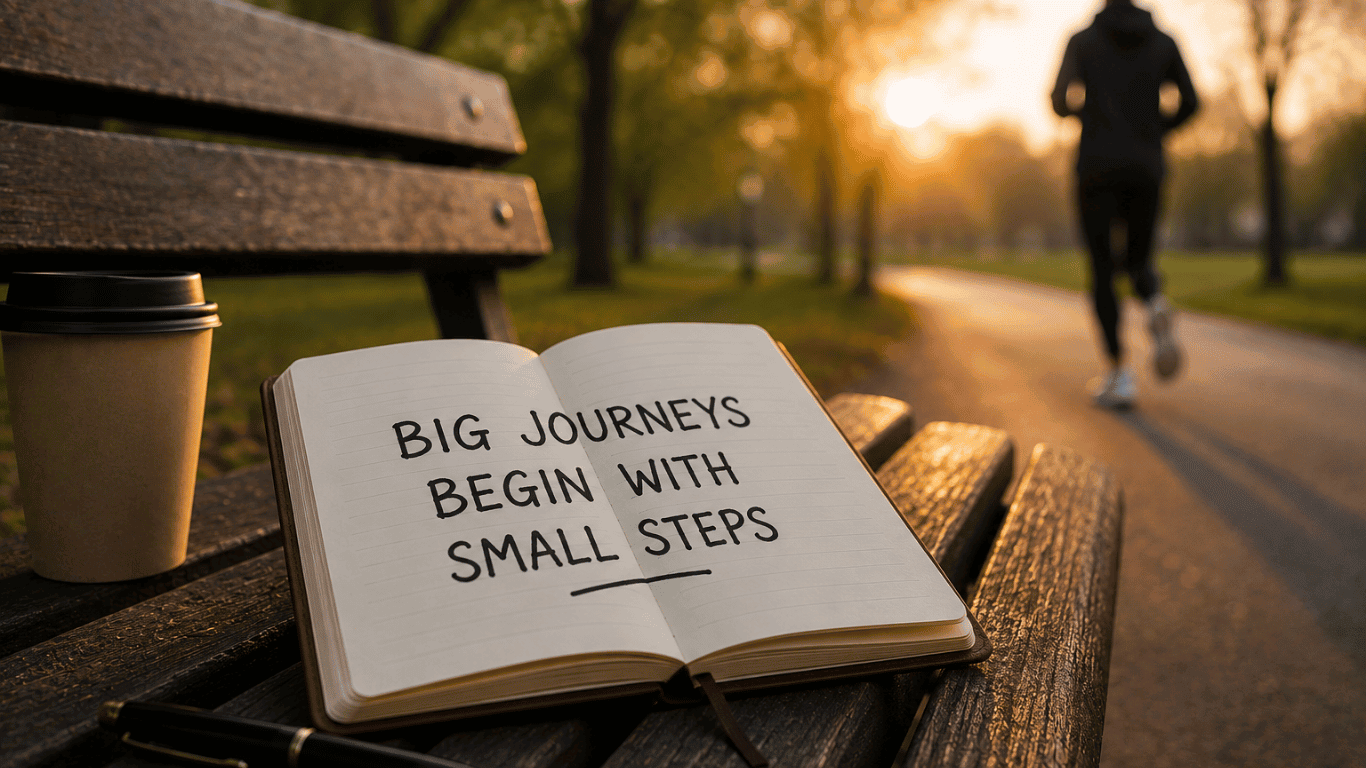

Curiosity and personal growth are more closely connected than we often realize.
We tend to imagine that growth begins with a clear goal. We choose a direction, make a plan, and then try to become disciplined enough to follow it. Yet many of the changes that matter most begin one step earlier—before the goal, before the plan, and often before we feel ready.
They begin with a question.
What if there is another way? What is this experience trying to show me? What would happen if I tried one small thing and paid honest attention to the result?
Curiosity opens the space in which growth becomes possible. It does not ask us to already know the answer. It simply invites us to look again at something we may have judged too quickly.
Sometimes a new perspective changes the whole experience
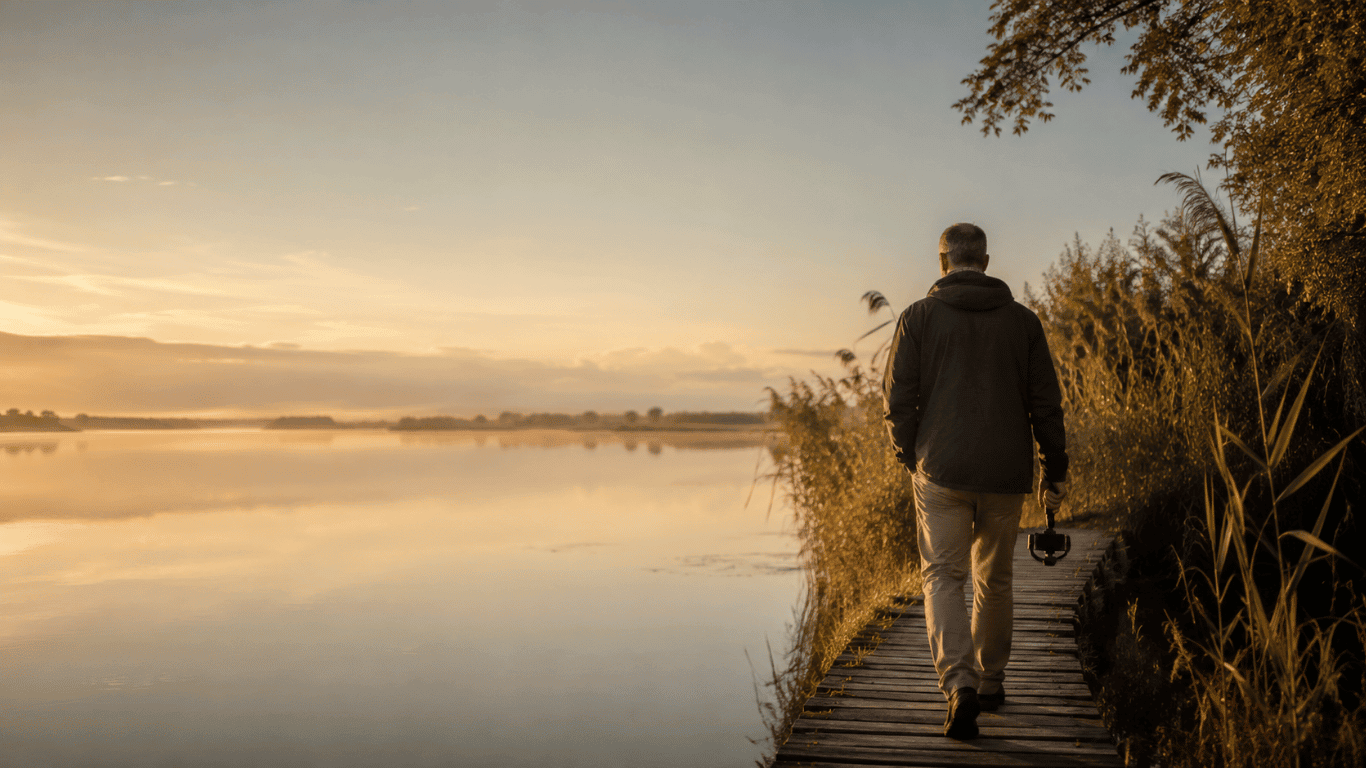
I noticed this recently while learning to film with a gimbal. At first, most of my attention went toward techniques, settings, camera angles, and the question of whether I was doing it correctly. During one walk, I made a simple shot that began among the reeds and slowly opened into a wide view of the landscape.
The place itself had not changed. My attention had.
A familiar walk suddenly felt like the opening scene of a film. The camera did not create the experience. Curiosity helped me notice what had been there all along.
That moment reminded me that personal growth is not always a dramatic transformation. Sometimes interest simply returns. We begin to observe again. We experiment. We notice possibilities in places that habit had made ordinary.
What curiosity really means
Curiosity is often confused with the desire to collect information. But the modern world does not suffer from a shortage of information. We can scroll through hundreds of ideas without allowing any of them to change the way we think or live.
Real curiosity goes deeper than consumption. It is the willingness to approach the unknown, the uncertain, or the complicated with attention before judgment.
Psychologists Todd Kashdan, Paul Rose, and Frank Fincham described curiosity as a positive motivational system connected with recognizing and pursuing novelty and challenge. Their work linked curiosity with exploration, deep engagement, and opportunities for personal growth. Read the study via its DOI.
This is an important distinction. Curiosity does not mean constantly chasing something new. It means being present enough to notice what we do not yet understand.
Growth begins when certainty loosens
What keeps us stuck is not always a lack of intelligence, ambition, or opportunity. Sometimes it is the quiet certainty that we already know what a situation means.
I have already tried. I am not good at this. Things like this do not work for people like me. There is no point beginning unless I can do it well from the start.
These statements sound like conclusions, but they are often old interpretations. Curiosity gently turns conclusions back into questions.
Instead of asking, “Why can I never stay consistent?” we might ask, “Under what conditions does consistency become easier for me?”
Instead of saying, “I failed,” we can ask, “What did this attempt reveal about the system I was using?”
And instead of waiting for confidence, we can ask, “What is the smallest safe experiment I can try today?”
The situation may not change immediately. Our relationship with it does. We stop defending an old identity and begin exploring a new possibility.
Curiosity makes learning more alive
Curiosity does more than make life interesting. It can also influence how we learn.
A neuroscience study by Matthias Gruber, Bernard Gelman, and Charan Ranganath found that people remembered information better when they were highly curious about it. The same curious state also improved memory for some incidental material presented nearby. Read the study in Neuron.
This helps explain why forced learning can feel heavy while a self-chosen subject can hold our attention for hours. When we genuinely want to understand something, effort no longer feels like obligation alone. It becomes part of discovery.
That matters when we are learning a skill beside a full-time job, building a healthier routine, beginning a creative practice, or developing an online system. We cannot depend on constant motivation. Curiosity gives us a quieter reason to return: there is still something here to understand.
Curiosity changes our relationship with discomfort
Growth usually includes uncertainty. We become beginners again. We make mistakes in front of others or quietly on our own. We discover that our first idea was incomplete.
Without curiosity, that discomfort can look like evidence that we should stop. With curiosity, the same discomfort becomes information.
A failed attempt can reveal what needs to change. A difficult feeling can expose an old pattern. An unfamiliar tool can open a new form of creativity.
Curiosity does not remove fear. It simply gives fear less authority. It helps us stay with an experience long enough to learn from it.
Why adults gradually lose their curiosity
Most children do not need to be taught to ask questions. They explore because the world still feels open. As adults, we gradually become more concerned with efficiency, responsibility, and predictable results.
There are practical reasons for this. Work, family, finances, and everyday tasks require structure. But when every hour becomes something to complete, the empty space in which interest appears can disappear.
We may also fear looking inexperienced. Curiosity requires the humility to say, “I do not know yet.” In a culture that rewards certainty and fast answers, that can feel uncomfortable.
The digital world adds another layer. It gives us endless novelty, but novelty is not the same as curiosity. Infinite scrolling changes the object of our attention every few seconds. Real curiosity gathers attention around one meaningful question.
A useful distinction: Digital noise keeps changing the subject. Curiosity stays with a question long enough for understanding to emerge
I have begun to see curiosity as a way back into life
Lately, I have noticed that curiosity is appearing in more than my videography. It is present in the way I observe myself, the way I look at familiar surroundings, and the way I learn new things.
In the past, I often wanted a quick answer when something went wrong. I immediately looked for what I had done badly. When I felt uncertain, I wanted to move through the feeling as quickly as possible. Now I am learning to pause before turning the experience into a judgment.
Why did this situation affect me so deeply? What am I trying to prove? What do I actually need in this moment?
These questions do not always produce immediate answers. But they create a little space between the experience and my reaction. Inside that space, I do not have to blame myself at once. I can first observe what is happening within me.
I experience the same thing when I go out to film or walk. I do not have to travel far to discover something new. A different path, a new camera movement, or a change in the light can be enough to make a familiar place feel different.
Perhaps this is why learning videography feels so valuable to me now. It is not only giving me a new skill. It is teaching me to pay attention, to experiment, and to stop expecting myself to do everything perfectly at the beginning.
I am trying to approach technology and AI in a similar way. I do not want them to provide ready-made answers for my life. I use them as tools that can help me organize a thought, develop an idea, or test something that previously existed only as a vague possibility.
The same realization connects these experiences for me: when I do not rush to close every question, I leave more room for discovery. Curiosity slowly brings me back to the present—to the life already happening around me.
How to cultivate curiosity in everyday life
Curiosity does not require a complete lifestyle change. It can be rebuilt through small, ordinary practices.
- Turn one judgment into a question. When you notice a final conclusion forming, pause and ask: what else might be true?
- Follow one meaningful thread. Give yourself fifteen uninterrupted minutes to explore one subject that genuinely interests you instead of collecting ten unrelated ideas.
- Practise being a beginner. Choose a skill in which progress is visible but perfection is unnecessary. Let learning itself count as success.
- Take a curiosity walk. Release the usual destination and notice the light, sounds, movement, buildings, nature, or small details you normally pass without seeing.
- Create before you consume. Write a paragraph, film a short scene, sketch an idea, or build a simple test before opening more content.
- Keep one question alive. Write down something you do not need to answer immediately. Return to it across several days and notice how your response changes.
These practices make growth human-sized. You do not need a complete transformation plan. You only need enough openness to take the next honest step.
Curiosity also needs direction
Curiosity can become another form of distraction if every new interest pulls us away from what matters. Conscious curiosity is not endless wandering. It has a centre.
A useful question is: “Is this interest helping me understand myself, develop a valuable skill, improve my life, or create something useful for someone else?”
Not every curiosity needs to become a project. Some are simply moments of wonder. But the questions that keep returning may reveal where energy, meaning, and genuine interest are still alive within us.
The first step is not having the answer
Personal growth is often presented as a path of certainty: define the future, believe in it, and move forward without doubt. My experience has been quieter than that.
Change often begins when I become willing to question the story I have been repeating to myself. Then I try one small possibility. Over time, experiments become experience, and experience slowly becomes a different way of living.
You do not need to know exactly where every interest will lead. You only need to notice what makes you more awake, more present, and more willing to learn.
Growth rarely begins with certainty. It begins with curiosity—and with the courage to follow one honest question a little further than before.
A quiet next step: Choose one area of your life where you feel stuck. Do not try to solve it immediately. Write one better question about it, then give that question fifteen minutes of undivided attention.