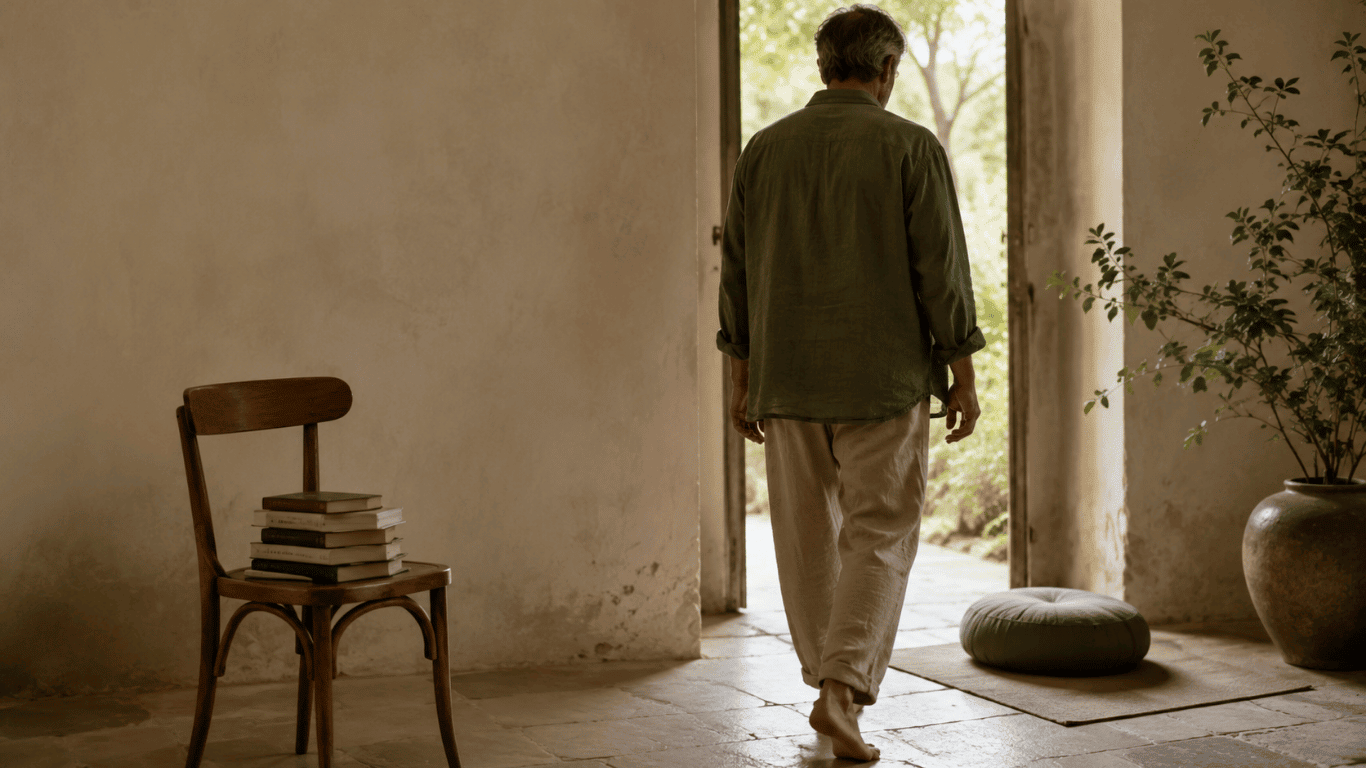

The hidden patterns that keep us stuck.
What’s really behind your fear is often more complex than the possibility of failure. Fear of change can be shaped by past experiences, automatic patterns, familiar emotional reactions, and the mind’s natural preference for predictability.
These hidden patterns can keep us inside our comfort zone even when we know that our current situation no longer feels right. We may continue preparing, gathering information, or waiting for the perfect moment—not because we lack knowledge or ambition, but because taking action would lead us into the unknown.
To understand what is really behind our fear, we need to look beyond the moment of hesitation. We need to examine how old experiences influence our present decisions, why familiarity can feel safer than change, and how curiosity can help us move forward.
The deeper question is not simply:
What am I afraid of?
It is:
What is this fear trying to protect me from—and does that protection still belong to the life I am living today?
Fear Is Not the Enemy
Fear is a natural part of being human. One of its purposes is to protect us from danger.
The problem is not that we experience fear. The difficulty begins when the mind no longer distinguishes clearly between genuine danger and the unfamiliar.
Our familiar life may not be fulfilling, but it is predictable. We know its rules, its problems, and even its disappointments. We have learned how to function within it.
A new decision, however, contains uncertainty.
What will happen if I start meditating?
What will happen if I publish my first article?
What will happen if I begin building the business I have been thinking about for years?
What will happen if I truly change?
The mind does not always choose what could be better for us. It often chooses what it already knows. We can easily confuse familiarity with safety.
Fear does not always mean that we are moving in the wrong direction. Sometimes it simply means that we are entering a place where we have no previous experience.
I often find myself at the opposite end of this spectrum. I tend to begin before I have every answer. I take risks—sometimes perhaps too many of them.
That does not mean I never feel afraid. It means that, for me, curiosity and the desire to act sometimes become louder than the fear.
When the Past Quietly Continues Within Us
Joe Dispenza’s ideas have had a strong influence on the way I look at our habitual reactions.
When we repeat the same thoughts, experience the same emotions, and respond to similar situations in the same way for long enough, these patterns can gradually become automatic.
Eventually, it no longer feels as though we are making a conscious decision. We simply react.
A past failure says:
Do not try again.
An old criticism says:
You are not good enough for this.
A previous disappointment says:
Do not trust it too much. You will only get hurt again.
These messages may no longer appear as clear, conscious thoughts. We may experience them only as tension, uncertainty, resistance, or the urge to procrastinate.
We do not always remain stuck because we are lazy or lack willpower. Sometimes an old protective response is trying to save us from a pain that may no longer belong to the present moment.
I recently became aware of this during meditation.
If I continually tell myself the story of what my past was like, and search for the same old wound behind every difficulty I experience today, I may continue to see myself through the story of my past.
I cannot change what happened. But I can change the way I relate to it today.
This does not mean denying the past or pretending that nothing happened. It means that we do not have to turn every new experience into another chapter of an old story.
What we are able to notice no longer controls us completely from the shadows.
Where Did Our Curiosity Go?
As children, curiosity came naturally to us. We touched things, asked questions, experimented, fell down, and stood up again.
We did not demand certainty before every step.
Later, performance, comparison, criticism, and fear of failure entered our lives. We learned that mistakes could have consequences. Other people could judge us. Sometimes remaining quiet felt safer than asking a question or trying something unfamiliar.
Our curiosity did not disappear. It simply became covered by layers of fear and difficult experiences.
Fear asks:
What if it does not work?
Curiosity asks:
What might happen if I try?
The difference may appear small, but each question creates a completely different inner state. The first closes the door to possibility. The second leaves it slightly open.
Perhaps courage is not the first thing we need. Perhaps we first need to relearn how to look at the unknown with curiosity.
We Do Not Have to Change Everything at Once
Automatic patterns rarely disappear because of one dramatic decision. More often, they begin to change through small, conscious choices.
1. Observe Your Reaction
The next time you notice yourself procrastinating, do not immediately criticize yourself. Pause for a moment and observe what is happening within you.
What am I trying to avoid?
Am I avoiding the task—or the feeling the task creates in me?
The purpose is not to judge the reaction. It is simply to see it more clearly.
2. Ask What You Are Really Afraid Of
Perhaps you are not afraid of beginning itself.
You may be afraid of failure, disappointment, or the judgment of other people. But it is also possible to fear what might happen if you succeed and have to accept greater responsibility for your life.
A more precise question often leads to a more honest answer.
3. Make the First Step Smaller
You do not have to begin with thirty minutes of meditation. Two minutes of silence may be enough.
You do not have to write an entire book today. You can begin with one honest paragraph.
You do not have to build a complete business in a day. It may be enough to finish the one task that genuinely moves it forward.
A small step does not mean having a small goal. It means reducing change to a form that we can act on from where we are today.
4. Replace Certainty With Curiosity
You do not need to know that everything will work out.
It may be enough to say:
I do not know where this will lead, but I am curious to see what happens if I take this one step today.
Curiosity does not remove fear. It creates space for something new beside it.
When the Inner Conflict Becomes Exhausting
Our fears and automatic patterns do more than keep us in the same place. Over time, they can also exhaust us.
It is tiring to long for a different life while talking ourselves out of it every day. It is tiring to keep adapting to a way of living that no longer feels right for us.
Sometimes it is not only the work itself that drains our energy. Inner resistance, lack of control, loss of meaning, and the feeling of being permanently on alert can also wear us down.
Burnout is therefore not always simply the result of working too much. Sometimes it also grows from living in conflict with what we genuinely want for too long.
Change Does Not Begin When Fear Disappears
The perfect moment when we no longer feel afraid may never arrive.
But we do not have to wait for it.
Change begins when we notice the old pattern but do not automatically follow it. It begins when we place one conscious moment between the familiar reaction and our next action.
A question.
A different choice.
One small step.
If the same inner patterns continue to direct us, we are likely to keep recreating similar results. But when we begin observing those patterns with curiosity, new possibilities can gradually appear.
Change does not begin when fear disappears. It begins when we become more curious about what may exist beyond our fear than we are attached to what we already know.
One Practical Next Step
It is worth noticing not only what we fear or what we are trying to avoid. We can also ask ourselves:
What inner state would I like to strengthen in place of these old fears?
If you would like to take this reflection further, Marci Shimoff’s free Happy for No Reason Workbook may be a useful next step.
The workbook includes 21 practices for raising your happiness set-point, a self-reflection questionnaire, and a collection of insights from Happy for No Reason. You can access it by entering your first name and email address.