
Affiliate disclosure: Some links in this article are affiliate links. If you sign up or make a qualifying purchase through them, I may earn a commission at no extra cost to you.
Why So Many People Feel Trapped by Time
Most people don’t wake up one morning and decide they want an online business.
Usually, something else happens first.
They feel stretched thin.
Their calendar is full, but their bank account doesn’t reflect the effort they’re putting in. They work hard, meet deadlines, and fulfill responsibilities, yet there’s a lingering feeling that life has become a cycle of trading hours for income.
There is nothing inherently wrong with that arrangement. Stable employment has helped millions of people build meaningful lives and support their families.
The challenge appears when life becomes less predictable.
A child gets sick.
An unexpected expense arrives.
A company restructures.
A parent needs care.
Suddenly, many people realize how little flexibility they actually have.
The issue isn’t work itself.
Work can be rewarding, purposeful, and fulfilling.
The deeper issue is often a lack of options.
When every dollar depends on today’s effort, uncertainty can feel heavier than it should.
That realization often leads people to explore online business opportunities. Somewhere along the way, they encounter a phrase that has been repeated so often it has almost lost its meaning:
“Make money while you sleep.”
The phrase has been abused by marketers for years.
Yet beneath the hype is a simple idea worth understanding.
Not passive income.
Not overnight success.
A system.
And one of the most practical systems available to modern entrepreneurs is the sales funnel.
What a Sales Funnel Really Is
The word “funnel” tends to sound more complicated than it actually is.
Many people imagine complex software, endless automation, and advanced marketing tactics.
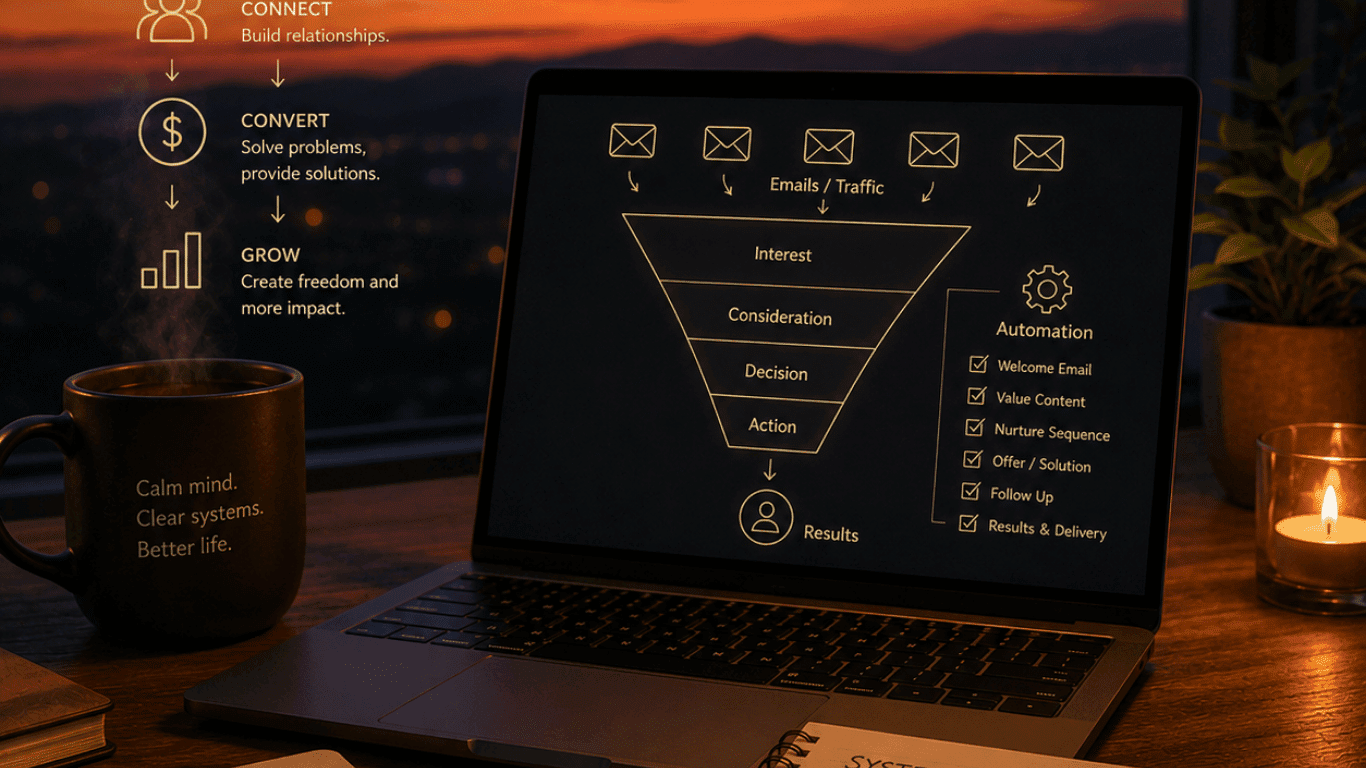
In reality, a sales funnel is simply a structured path that helps people move from curiosity to action.
Think about the last time you bought a book, enrolled in a course, or subscribed to a newsletter.
You probably didn’t make the decision instantly.
You discovered something interesting.
You learned more.
You gained confidence.
Then you took action.
A funnel simply supports that journey.
A basic example might look like this:
- Someone discovers a useful article.
- They download a free guide.
- They join an email list.
- They receive helpful information over time.
- They decide whether a product or service is relevant to their needs.
That’s it.
At its best, a funnel isn’t about pushing people toward a purchase.
It’s about helping people make informed decisions.
The strongest funnels feel less like marketing and more like guidance.
They provide the right information at the right moment.
They reduce confusion.
They answer questions before those questions become obstacles.
Why Systems Matter More Than Motivation
Many people try to build a side business through pure motivation.
They wake up inspired.
They create content.
They work late into the evening.
Then life gets busy.
Energy drops.
Progress slows.
The problem isn’t motivation.
Motivation was never designed to carry us indefinitely.
Systems are what carry us forward when motivation fades.
This principle applies everywhere.
Someone who wants better health benefits from systems around exercise and nutrition.
Someone who wants financial stability benefits from systems around saving and investing.
Someone who wants to build an online business benefits from systems that consistently attract, educate, and serve people.
A sales funnel is simply one of those systems.
It helps create consistency when daily life becomes unpredictable.
And consistency is often more valuable than intensity.
Why Funnels Work Around the Clock
People need rest.
Systems don’t.
A well-designed funnel can continue performing simple tasks regardless of the time of day.
It can:
- Capture leads
- Deliver resources
- Send educational emails
- Answer common questions
- Recommend relevant products
- Guide people toward next steps
Whether someone visits your website at noon or midnight, the experience remains consistent.
That consistency creates leverage.
Leverage isn’t about doing less.
It’s about making your effort go further.
Imagine answering the same question fifty times.
Now imagine creating a resource that answers that question automatically.
The work still happened.
You simply completed it once instead of fifty times.
That difference matters.
Over months and years, small efficiencies compound into meaningful results.
The Hidden Connection Between Systems and Stress
One observation keeps appearing in both life and business:
Uncertainty creates stress.
When everything depends on today’s effort, pressure builds quickly.
You feel responsible for every outcome.
Every missed day feels costly.
Every slow week feels alarming.
This pressure often leads to reactive decision-making.
People jump between strategies.
They chase trends.
They abandon projects before those projects have time to mature.
Systems help reduce that pressure.
Not because they guarantee success.
Nothing does.
But because they create predictability.
A blog that attracts visitors every month creates predictability.
An email marketing system that nurtures relationships creates predictability.
An automated sales funnel that consistently guides people through a process creates predictability.
Predictability doesn’t eliminate uncertainty.
It simply reduces unnecessary chaos.
And when chaos decreases, clarity increases.
Automation Is Not About Avoiding Work
One of the biggest misconceptions in online business is that automation exists so people can stop working.
I’ve never found that perspective particularly helpful.
Automation works best when it supports meaningful work rather than replacing it.
Consider a teacher.
If the teacher records lessons so students can access them anytime, the teacher hasn’t stopped working.
The teacher has simply made their expertise more accessible.
The same principle applies to business.
Automation handles repetitive tasks.
Humans handle creativity, relationships, decision-making, and improvement.
The goal isn’t to escape effort.
The goal is to direct effort toward higher-value activities.
That’s where freedom begins.
Not by avoiding responsibility.
But by choosing where your attention is most valuable.
Why Beginners Should Pay Attention
Many newcomers assume funnels are only useful once a business becomes large.
Ironically, beginners often benefit the most.
When you’re starting out, resources are limited.
Time is limited.
Experience is limited.
Energy is limited.
Structure becomes incredibly valuable.
Without structure, it’s easy to feel overwhelmed.
You publish content without a clear purpose.
You attract visitors but lose contact with them.
You start projects but struggle to follow through.
A simple funnel creates direction.
It provides a path rather than a collection of disconnected activities.
That doesn’t guarantee results.
But it does reduce confusion.
And reducing confusion is often one of the fastest ways to make progress.
The Power of Follow-Up
Most online business advice focuses on attention.
Get more traffic.
Get more followers.
Get more views.
Attention matters.
But relationships matter more.
Trust rarely develops during a single interaction.
People need time.
Time to learn.
Time to evaluate.
Time to understand whether something is right for them.
This is where email continues to stand out.
Despite the rise of social media platforms, email remains one of the most effective ways to maintain meaningful communication.
A thoughtful email marketing system allows you to continue helping people long after they discover your content.
Technology handles delivery.
Human insight provides value.
The combination is powerful.
Building Digital Assets Instead of Chasing Results
One shift that changed how I view online business was moving my focus away from immediate outcomes and toward asset creation.
Results matter.
But assets often matter more.
A single blog post can attract readers for years.
An email list can grow steadily over time.
A lead magnet can continue generating subscribers.
A sales funnel can continue guiding people through a useful process.
Each asset may seem small individually.
Together, they become something much larger.
They become infrastructure.
And infrastructure creates resilience.
When people talk about freedom, they often imagine dramatic moments.
Selling a company.
Retiring early.
Sometimes those moments happen.
More often, freedom develops gradually.
One asset at a time.
One system at a time.
One intentional decision at a time.
Technology as a Tool for a Better Life
Technology receives plenty of criticism.
Some of it is deserved.
Modern technology can distract, overwhelm, and consume attention.
But technology itself is neither good nor bad.
Its impact depends largely on how we use it.
Used carelessly, technology amplifies noise.
Used intentionally, it amplifies capability.
A funnel is simply one example of intentional technology.
It allows repetitive tasks to happen automatically while preserving human attention for more meaningful activities.
Family.
Health.
Learning.
Creativity.
Relationships.
The objective isn’t to build a business that dominates every waking hour.
The objective is to create systems that support the life you actually want to live.
Freedom Is Usually Built Quietly
One reason many people overlook systems is because systems rarely look exciting.
They aren’t dramatic.
They don’t produce instant transformation.
They’re often repetitive and unglamorous.
Yet most meaningful progress follows this pattern.
Financial stability is built through repeated decisions.
Strong relationships are built through repeated interactions.
Businesses are built through repeated actions.
The same is true for freedom.
Freedom is rarely the result of a single breakthrough.
More often, it’s the result of hundreds of small choices that compound over time.
A saved dollar.
A published article.
A growing email list.
An improved process.
A better system.
Individually, these actions seem insignificant.
Collectively, they can change the trajectory of a life.
Frequently Asked Questions
What is a sales funnel?
A sales funnel is a structured process that guides potential customers from initial awareness to a final decision. It helps people receive information, build trust, and take action when they are ready.
Is a sales funnel only for experienced marketers?
No. Beginners often benefit significantly from having a simple funnel because it creates structure, reduces confusion, and improves consistency.
How does an automated sales funnel work?
An automated sales funnel uses technology to handle repetitive tasks such as collecting leads, sending emails, delivering resources, and following up with potential customers.
Why is email marketing important in a funnel?
Email allows you to maintain communication with people over time. Since trust often requires multiple interactions, email helps build stronger relationships and provide ongoing value.
Can a funnel create passive income?
A funnel can automate parts of a business, but it is not a guarantee of passive income. Most successful funnels require ongoing maintenance, content creation, and improvement.
What tools are commonly used to build funnels?
Many businesses use website builders, email marketing platforms, landing page software, and customer relationship management tools. The best choice depends on the business model and goals.
How long does it take to see results from a funnel?
Results vary widely. Some businesses see engagement quickly, while others require months of testing, learning, and optimization. Consistency tends to matter more than speed.
Final Thoughts
The idea of waking up to new leads, subscribers, or sales can certainly be appealing.
But the deeper value of a sales funnel has very little to do with overnight success.
Its real value lies in creating structure.
Reducing unnecessary friction.
Helping people consistently find value.
Building assets that continue serving others long after the original work has been completed.
A funnel won’t solve every challenge.
It won’t remove uncertainty.
And it certainly isn’t a shortcut to wealth.
What it can do is create a more sustainable way of building something meaningful.
The more I study businesses, finances, habits, and decision-making, the more I notice the same pattern appearing everywhere.
Freedom isn’t usually built through dramatic action.
It’s built through thoughtful systems.
One process.
One asset.
One decision at a time.
And perhaps that’s encouraging.
Because it means meaningful change is available to ordinary people willing to take small, consistent steps forward.
If you’d like to see how affiliate marketing, email marketing, and automated sales funnels work together, explore the ClickBank Profit Club.
👉 Learn More About ClickBank Profit Club



Pingback: Build Digital Assets, Not Just Income